Thursday, 25 July 2019

The Fourth Industrial Revolution - The future is here! Or is it?


What is the Fourth Industrial Revolution, referred to as 4IR?

The Four Revolutions
Source:.www.salesforce.com

As the history books would suggest, the First Industrial revolution was the advent of the steam engine in the 18th Century, ushering in the Age of Mechanical Production. Steam was the primary source of power for everything from agriculture to manufacturing. The world became dependent on steam power and machine tools when steamships and steam engines (railroad) were the revolutionary way of long distance transportation. Through steam power, the agrarian life steadily gave way to urbanization, with the founding of the factory being the centre of community life.
With the factory being the driving force behind economic and social growth, Industrialization gave rise to a middle class of skilled workers. Cities, Industries and economies grew phenomenally with this new Age of Industrialization, as populations in US cities, for example, grew from only 6% in the 1700s to around 40% in the 1800s.

The invention of the petrol engine, telephone, and electricity in the 20th Century transformed the way people lived, as these new inventions expanded the labour workforce in cities. Production lines in factories began taking shape as the Ford motor company was the first to introduce the concept of the assembly line in factories. The explosion of scientific and Industrial inventions in the 19th and 20th Centuries ushered in what would become the Modern World of today. The Age of Science and Mass Production thus became the Foundation for the exploration and expansion of Science and Technology in Industry.

The age of the Digital Revolution in the late 20th Century saw the invention of the semi-conductor; transistor and microprocessor introduce Digital computerisation in mainframes and Personal Computers. Devices like TVs, wireless, telephones and other analogue appliances were replaced with digital electronic technology. Industries mostly impacted were Information Technology, Telecommunications and Energy, as antiquated analogue Infrastructure mutated into high-speed digital telecommunications, and advancements in the Energy Industry saw the development of Nuclear energy as a (cleaner) source of energy over traditional coal powered (dirty) energy production. Another Industry highly impacted was the Media, where the Internet (Network) gradually became a primary source of information as Media houses converted their products into electronic formats, and used the Internet as a more efficient channel of delivery. The Digital revolution transformed most Industries worldwide and changed the way people would live, work and communicate.

Today we have the Fourth Industrial Revolution, or simply 4IR, the name and definition as branded by Klaus Schwab, Founder and Executive Chairman of the World Economic Forum. Technological developments such as Artificial Intelligence, Robotics, Cloud computing, Internet of Things (IoT), and Virtualisation has set the tone for the age of Cyber-Physical systems. Cyber-Physical systems are characterized by a fusion of technologies that integrates the physical, digital and biological domains. Mechanical automation through robotics in Industries like Construction, Manufacturing, and the Service sector has become a sobering reality. Breakthroughs in Biotechnology have enabled the possibility of genetic sequencing and editing in the drive to cure diseases like cancer, leukaemia, Androgenetic Alopecia, etc.

Block-chain technology (an Algorithmic Distributed Ledger), the platform from which Cryptocurrencies were launched, are increasingly being used in supply chain and tracking Industries. Cryptocurrencies were developed as an alternative to Fiat currencies, and has effectively made trading between two entities more secure, with an explicit aim of removing the middle man, i.e. Banks. Exchange trading markets for Cryptocurrencies, have already been established in parallel with the traditional stock and derivative markets.

As more and more electronic devices are Internet enabled, the demand for cyber information space has skyrocketed.  By 2018, a total of 23 Billion devices were connected to the Internet, with this number increasing daily. IoT devices range from a light bulb that can be switched on through a smartphone app, to smart cities with public enabled sensors that collect valuable data in an effort to improve communities and to better understand and control the environment. Other ground breaking technologies like Artificial Intelligence and 5G has already been inducted into Asian and European Societies as the benchmark for the future.

There is absolutely no doubt that the amalgamation of 4IR into Societies and economies have untold benefits and endless possibilities. It can raise salary bands, improve the quality of life and decrease the cost of trade. Through Automation, production processes and product delivery in manufacturing can be streamlined with a higher level of accuracy, quality and efficiency. 3D printing can potentially increase productivity and market growth by approximately 40%, as advanced robots can program multiple product designs, speedily manufactured by efficient 3D printers.

The development of a number of Smart Cities in the Far East has already embedded the Fourth Industrial Revolution into mainstream society across South East Asia. In the United States, this trend is spread through various states, like Colorado, Pennsylvania, California, Kentucky, etc.  What sets these advanced cities apart from the rest of the world? They all have stable and fast growing economies, a robust world class infrastructure, and a highly skilled workforce. Therefore, the Fourth Industrial Revolution as an enabler of smart cities was a natural progression.

Sadly, not in South Africa. So let’s get back to reality!

4IR in the South African Context

The huge challenges we face in the Social and economic spheres alone, is enough for the majority in this country to forget about the dream of living in a 4IR world. The economy has contracted by 3,2% in the first quarter of 2019, with a very low outlook for the second quarter. The unemployment rate has been steadily increasing over the last 5 years from 25.5% in 2014 to 27,6% in the first quarter of this year (2019), as more companies downsize their workforce to cut costs. Youth unemployment (25 to 34 years old) is at 34% and a staggering 55,5% for 16 to 24 year olds. These age categories are where the skills for 4IR should be exploited and developed, yet the economy is not strong or stable enough to absorb them.  

South Africa is well known for being the most unequal society in the world, where 10% of the population earns more than 50% of total household income in the country. The poorest 40% earns less than 7% of household income.  The significance of this indicator is the reflection of how many unskilled and semi-skilled people there are in the mainstream economy earning minimum wages. With the development of Automation in 4IR, these are the very people whose jobs are targeted. The Industries already impacted, as mentioned, are Agriculture,Manufacturing, Construction and the Service Sector, where most unskilled and semi-skilled individuals ply their trade. The effect this could have on the current Inequality gap would border on criminality. The already marginalized, would not only be excluded from access to the benefits of 4IR, but would also be removed from the labour force driving it!

Blight on Education and Infrastructure

A low Matriculant pass rate (compared to the number of grade 1 students through twelve years of primary and Secondary Education), followed by an even lower (entrance) submissions to an institution of higher learning poses interesting challenges to the skills development required for the Science and Information and Technology Fields. Currently there is a drain of scarce skills required in the Coding and App Development disciplines of Information Technology. This is directly attributed to the low numbers of Students registering for Study in the field of Science and Technology, which is a result of the low numbers matriculating with the required exemption in the Mathematics and Science category of subjects. We find a similar trend of scarce skills in the fields of Mechanical, electrical and Civil engineering, where these make a significant contribution to the infrastructural fields of 4IR.

As Industry evolves, a disruption in labour trends is inevitable. The last three revolutions have proven that various job skills were phased out with new professions replacing them. The downside of this transition is that the number of job losses through automation and other disruptions, is not proportional to the number of new jobs and professions created. The trend of new job creation through Industry disruptions has been significantly downward. Currently, only 0,5% of the US workforce is employed in Industries that did not exist before the 21st Century, compared to 8,2% of the workforce in new Industries in the 1980s and 4,4% in the 1990s. In addition, the type of jobs created required a higher level of education and skill, compared to the skill levels required for the jobs that were lost. In other words, most Blue-collar jobs are affected.

In South Africa, currently only 15% of the population has access to or can afford Broadband Internet technology. Yet, 50% of the population are connected by smart phones through mobile data access, which have become a daily necessity. It’s anticipated that advanced IoT applications are being developed for the 5G Telecommunications Infrastructure. Our Broadcasting Infrastructure has not yet been migrated from analogue to digital broadcasting, which is required to free up frequency spectrum for mobile data connectivity and to expand the access to broadband Internet for the rural market of smartphone users.

Notwithstanding all the challenges mentioned above which are crucial to the successful rollout of a 4IR South Africa, the most fundamental challenge we face is the problem of keeping the lights on. Our energy supply from Eskom is stuck in the second and third revolutions. Ageing and outdated coal powered plants, have proven to be an Achilles heel for the survival of the South African economy. More than 90% of our energy generation is supplied by failing power plants, which have reached its expiry date years ago. If that is not enough, the Power Utility has all but gone bankrupt with Treasury continuously bailing it out with loans which it may not be able to repay. The successful funding and rollout of IPPs around South Africa has made very little difference in the constraints of energy supply. Unless the energy sector is radically transformed and regulated to meet the current requirements of our economy, 4IR for the majority of South Africa will be nothing but a pipe dream.

Conclusion

In the last fifty to seventy years, the pace of change in Industry and thus Society has quadrupled compared to the pace of change of the first two revolutions. The number of inventions and discoveries in Science and Technology more than doubled in the space of a few decades compared to the period (approximately two Centuries) between the first and second Industrial Revolutions. The next revolution may only be a few years away as Millennial innovation radically change the Social and Economic landscape. Through the process there will be winners and losers, though historically, the most vulnerable of Society become the losers. In a race to patent, market and sell a new invention, businesses tend to forget or conveniently forget the implications and repercussions a new invention may have on Society, focusing mainly on the advantages it will have to the few who may be fortunate enough to gain access to it. 

In Africa and specifically South Africa, whose economy is still an “emerging” one, would the 4IR be a justified necessity, where only a handful of the population would benefit from it? 


Sunday, 24 March 2019

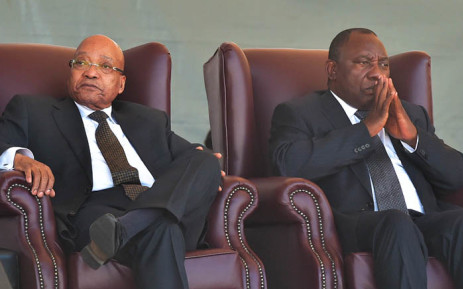
The Zuma Elite is alive, kicking and seemingly have played with an open hand.

Image result for Zuma and Ramaphosa
Source: EWN

If you know the enemy and know yourself, you need not fear the result of a hundred battles. If you know yourself but not the enemy, for every victory gained you will also suffer a defeat. If you know neither the enemy nor yourself, you will succumb in every battle." - Sun Tzu, The Art of War.


My thoughts on the Opinion piece by Mark Swilling, The Zuma Elite is alive, kicking and preparing to replace Ramaphosa, as published on the Daily Maverick Website.

Firstly, I comprehensively agree with Mr Swilling on these points,
  1.     . Retaining Zuma’s “Man of the people” image;
  2.       Consolidate his power base in KZN;
  3.       Rounding up the various PEC executives in Zuma’s favour; 
  4.       Weakening the voter turnout against the ANC and;
  5.       Nullifying the State Capture Commission

However, his opinion on the Russians/Embassy-cum-military bases/global expansion may be far-fetched for an Academic of Mr Swilling’s stature.  The problem with these statements, firstly, is that Nuclear Energy build for peaceful Civilian purposes is conducted under supervision and inspection by the International Atomic Energy Agency (IAEA) to ensure the Nuclear Build processes are not manipulated for military purposes. Therefore the possibility that the Russians are using Civil Nuclear Power plants as a cover for an Embassy/Military base, could only occur if they (Russians) were not a signatory of the NPT, and were therefore under no obligation to allow IAEA inspection of their nuclear plants. Notwithstanding the fact that Mr Swilling neglects to provide some clear examples of said Embassies-cum-military bases.
Secondly, the point of the Russians using their Civil Nuclear Sector to expand their global ambitions does not mean that the Russian Federation has plans to control global nuclear energy proliferation as Mr Swilling is clearly implying, because they ALREADY control approximately sixty percent of nuclear energy trade globally, see here
Mr Swilling then suggests that South Africa would have become “….another Russian-controlled failed state held together with violence and fear”. I’m rather sceptical of the suggestion, because I’ve never heard of a Russian-controlled failed state, and am extremely disappointed Mr Swilling failed to provide an example of it.   Coupled with this he suggests, and again without providing the evidence, that “There is now more than enough evidence to suggest that the Russians want Ramaphosa out….” Mr Putin has suggested many a time that he is prepared, willing and able to work with any State leader under mutually beneficial terms, but will not allow terms to be dictated to the Russian State.
This Analysis and this Opinion piece, provides a comprehensive definition of how the Russian Federation and its leaders conduct their affairs of State. Suffice it to say, there remains the scepticism in the West that the Russian Federation is the USSR of old, because they believe that nothing has changed since the fall of the Berlin Wall, and the subsequent collapse of the USSR. Nothing could be further from the truth, based on the articles mentioned above.

Coming back to the game being played by Zuma and his cohorts, I agree that there definitely is a huge fightback from the Zuma cartel. I also agree that there is some serious transformation needed in the ANC as the ruling political party. There definitely need to be some “Big Hitters” taken down and imprisoned for these changes to be effective.


However, while the Zuma cartel is busy showing their hand and being as predictable as anyone would be, in their situation (i.e. facing long term prison time), who is to say that Mr Ramaphosa is just sitting back and watching all of this unfold without having a Strategic plan of his own? In the lead up to the Elections in May, I think it would be expected from Mr Ramaphosa not to make any significant changes that may give the Zuma cartel a hint of his (Mr Ramaphosa’s) plan.  Therefore, appointing various Commissions of Enquiry was expected, a new NDPP was almost overdue, firing one or two Ministers was necessary. These were the basic non-negotiables Mr Ramaphosa needed to enforce in the period from being sworn in until the elections. We have to bear in mind that Mr Ramaphosa’s victory at Nasrec was too close for him to make sweeping changes across his Administration, which may have shortened his tenure as ANC leader.

For all intents and purposes, Mr Ramaphosa is in the most advantageous position given that he can predict what the Cartel has next on their agenda. Conversely, the Cartel could not know what Mr Ramaphosa’s response may be because he’s not showing his hand. There are various reasons why Mr Ramaphosa should be playing the long game. The most crucial of them is that the ANC needs votes come election time, and a premature counter attack from Mr Ramaphosa now, may have a worse impact on the ANC election result than what is currently expected.

Global stakeholders are watching and waiting to assess post-election Economic and Foreign policy, the resulting manoeuvres from State Capture and other Enquiries, and the fight against corruption from the Ruling Party, for their own interests.

The electorate can only hope and pray that Mr Ramaphosa IS playing the long game and have his game plan ready for some post-election surprises. Failing which, we all may have to pack our bags and head for the exit in an Exodus-like stampede.

Tuesday, 17 October 2017

uBaba Ka Duduzane: The Ultimate Strategist?

Source: The Citizen

Following the amusing analyses and predictions popping up in the media regarding P-P-Pr-r-r.e.s. Zuma’s (it’s rather difficult to refer to him as “President”) strategy for the upcoming ANC Elective Conference in December, I somehow couldn’t understand how these analyses could be attributed to the mind of one individual who:
  • Took a shower to wash down a potential  infection after having unprotected sex with an HIV positive woman;
  • Cannot read numbers containing more than 5 figures (some 6 year olds can read numbers containing more than 5 figures);
  • Feels threatened by “clever blacks”;
  • Recites a passage like a 5 year old who has just learned to read his first children’s book;

     What kind of in-depth analysis would one need, to make an assessment for such mind boggling stupidity of an individual? But, for the sake of satire, let’s unpack the reality and intellectual capacity of one Jacob Gedleyihlekisa Zuma. (And I will from here-on refer to him as anything but P-P-Pr-r.e.s.  Zuma)

There is an assumption that No. 1 is using his ex-wife, NDZ (Nkosasana Dlamini-Zuma) as a front to mask his real intention of making Zweli Mkhize his ultimate choice to take over the ANC reins.  There is another prediction that, should Cyril Ramaphosa win, he may cut a deal with MacBuffalo  to look the other way and prevent him from standing trial for his treacherous shenanigans. There are other assumptions of The Nkandla Crooner changing tact at the 11th hour, and making Baleka “I don’t recognise you” Mbete his running horse (pardon the pun); or the one where he plans to redeploy the two main threats (CR17 and Mkhize) to his preferred candidate (NDZ), and then proceed to secure a position for himself in the ANC top six where he can still manipulate things to his advantage. Then there is an analysis of why all the above will not transpire, and that Zuma intends to disrupt things to the extent that the conference does not take place, so that he remains Head Honcho until the General Elections in 2019 or until he’s ready to skip the country.

The only thing all of the above proves, is that no one really knows exactly what Mshini-Wam’s intention is, but the resounding agreement is that he definitely has no intention to stand trial for any crime, and return to that 6 x 8 foot cell for the rest of his criminal life. This, I would agree with, because this oke has no scruples and absolutely no sense of moral decency and will NEVER “fall on his sword” or negotiate a plea bargain with the new leaders.  Jacob G. Zuma believes that he is above reproach and stooping so low (in his little mind) as to admit that he fucked up big time, is not in his persona.

So here is my 10 cents worth of analyses and predictions.

uBaba Ka Duduzane is said to be a shrewd tactician, and a wily strategist.  This is ostensibly attributed to him being an avid chess player, and the chairman of the Chess Club during his time in incarceration on Robben Island.  I don’t, for one second, believe that he is any good in chess, although he learned to play the game on Robben Island when he was in his 20s. Being an honorary guest at the Commonwealth and South African Open Chess Championships in Port Elizabeth in 2013, he chose to play a 5 year old toddler in a game that ended in a stalemate.  Really? Playing a 5 year old little boy barely out of his nappies (Diapers)?  Some may argue it was an exhibition match or just a photo opportunity; but why choose the youngest kid at the tournament?  That said one cannot find any record of his chess prowess or how many significant games he has ever won. But, there is another report of him losing at a similar tournament to a 13 year old girl. Nonetheless, being the chairman of a chess club does not necessarily mean you are the best player in the club. For all intents and purposes, he may have been one of only two members in the club, with, probably his tutor as the second member! There is very little, if any, information on the web about the club and its members. In addition, we know for sure that he doesn’t (can’t?) read, so he may not be familiar with various chess strategies or open and closed games. To know these tactics and strategies, one should read to improve and understand how one plans a winning game.  

Artist: Zapiro

Since his rape trial back in 2006, controversy has followed him like a demon ready to take over his
soul. Amongst his many embarrassing sexploits and misadventures, was the rape of an HIV positive woman, his fathering a child with the daughter of a close friend, fraud and racketeering charges involving his “Financial Advisor”, and the latest Gupta-linked kak-storm hitting Mzanzi. Other stories emerged about his dodgy relationship with ex-convict-turned-politicians. How many cabinet reshuffles has he authorised since 2009? The level of corruption he is alleged to be embroiled in is staggering, to say the least.  One can write a book on the shit that this extra-terrestrial, sex-craved, wrecking ball homo-noid has wrought on everyone and everything for which he is accountable. But for fear of losing me in derision and for the purposes of this analysis, these few glaring examples should suffice to clarify the point.

Given all the controversial, criminal disasters he has engineered, and given the fact that each time he has been caught, literally, with his pants down, does that sound like someone who knows what he’s doing; someone who has this grand strategy that will dupe the whole country into believing he is the ultimate tactician and master of deflection?

I think not.
Artist: Zapiro

I think No. 1 has survived as long as he has, simply because he is surrounded by a plethora of
corrupt, thieving individuals just like him, and he has a folder for the criminal activities of each and every one of them, inside and outside of Government.  With this priceless information at his disposal, he knows he can do whatever his heart desires without suffering any incrimination at all. A case in point, his last cabinet reshuffle, was a big FUCK YOU to his ANC detractors and the country as a whole.  He is so confident, to the point of obstinacy, that he proceeded with the State Capture project by enacting said reshuffle of his most trusted lieutenants into the Ministry of Finance to finish the job. Suffice it to say, through courtesy of his Saxonwold handlers.

He doesn’t give a flying fuck about anything around him, least of all those pesky 783 corruption charges. I’m quite sure he doesn’t make ANY decisions or gives direction for his defence of said charges.  He leaves all of that up to his comrade-in-thieves to take care of, while he lounges at his fire-pool drinking his Umqombothi and summoning his wives one-by-one to (amuse) him…..in between pleasuring his head-bobbing masters from 5 Saxonwold drive. All he wants to hear is that his preferred candidate will succeed him at the Conference in December and that he’s not standing trial for anything.

I think the Showerhead will see the State Capture Project to its devastating end (as ordered by his head-bobbing handlers), wind things up, and charter a flight out to Mars, where Interpol can’t find him and therefore cannot be extradited. Given his infinite stupidity, he probably thinks that Mars is an island in a remote part of the globe, obscured from civilisation and inaccessible to normal people like you and I. But, under mounting public pressure his Saxonwold handlers may have a few surprises in store for him, or he for them…..there is no honour among thieves.

However, any predictions would be irrelevant should Pikkewyntjie (Shaun the Sheep) suddenly develop a backbone and decide to prosecute uBaba Ka Duduzane for those annoying 783 corruption charges, in which case, the Nkandla Crooner will be at his Karaoke best!

Sunday, 27 August 2017

State Capture and the democracy that was


The topic of Politics is always frowned upon in social circles and people are often reluctant to debate political issues or developments, given our historical political landscape.  I was recently asked not to engage in any political discussions at a social gathering, for fear of offending someone.  In my opinion anyone who feels offended by a political discussion, should engage in some serious self-reflection and re-evaluate their standing and contribution to society. However, and understandably, with a reflection on our political history, these discussions or debates can become awkward, tense, and in extreme circumstances, can turn violent.

I take a strong interest in politics, not because I have an affiliation to a specific political party or movement, or for that matter have some kind of ideological belief, but merely because I feel, as a citizen and taxpayer, we need to keep our politicians (on both sides of the spectrum) ethical and honourable in their duty to society; however difficult or impossible that may be.  Holding our politicians to account is every South African citizen’s moral obligation to ensure they deliver on their promises and to ensure the future of our kids are not compromised.  Social Media has become an extremely effective tool for the purposes of the aforementioned, and is the perfect platform for any reluctant individual to air their views.

This invariably brings me to the subject of State Capture. As any South African, whose eyes are open for a minimum of 10 hours per day, would know, the story of the Guptas make the front page of most newspapers and the leading story on local News channels, almost daily.  The phrase “state capture” describes how an immigrant Indian family, the Guptas, have manoeuvred themselves into a position where they wield control over state-owned companies with their huge procurement budgets, diverting large sums into their own pockets and, by extension, the President, his family and his circle of cronies. While I will not go into extensive detail and bore you to death about this sorry saga, I will attempt to highlight some of the repercussions which affect every South African, as a result of this State Capture. This may shed some light on why I suggest that every South African citizen worth their salt are obliged to hold politicians to account, in whichever way we can.  Suffice it to say, without the involvement of the average citizen and civil society, we expose ourselves to the kind of exploitation and blatant theft witnessed in this State Capture.

State Capture is probably the most controversial and embarrassing of events that had befell South Africa since the days of Apartheid. The daylight robbery of SOEs (State Owned Entities), like Eskom, SAA, SABC, Transnet, PRASA and Denel, brought a whole new level of corruption and white collar crime in this country’s young history. The corruption in the Arms Deal is dwarfed by the scale of corruption in the capture of our state. The figure punted by former Minister of Finance, Pravin Gordhan, in state corruption was around R100 billion, which roughly represents 10% of Government Expenditure. He emphasised that this money could have doubled Social Grants for the 17 million South Africans on Social Welfare. It could have built low cost houses for 5 million families, not to mention the number of schools or hospitals that could have been built. A R100 billion could have made a significant impact to the rate of unemployment through job creation.

The most embarrassing thing about this story is that the perpetrators central to this pilfering are uitlanders from the Indian sub-continent who saw the potential for grand scale larceny through our compromised public officials and a pliable Government administration. They were so enamoured with this potential that they arrogantly set a goal of stealing no less than R10 billion in liquid assets in a set time period. Their South African citizenship is under investigation, but this did not deter them from realising these goals. The corruption and theft extends globally and implicates various multinational corporations doing shady business with the Gupta family, and corrupt government officials.

The impact on ordinary South Africans is far reaching with the most vulnerable in society being affected directly. As mentioned, the 17 million beneficiaries of Social Welfare could have benefited the most, but instead face more controversy around non-payment of their social grants in 2018. Over 30 million people currently live below the poverty line which is more than half of the total population in this country.

The country is currently in a recession, brought about by the ratings downgrades of various State Owned Entities, and subsequently a downgrading in the economy’s investment grade. In the bigger scheme of things this implies that Foreign Direct Investment in South Africa slows down, with the possibility of an outflow of current investments; a case in point, the exit of Ford South Africa.

As a result of the downgrades, and with little or no future investments, the prospect of job creation becomes a non-entity, and thus unemployment increases. The official rate as at June 2017 stood at a mind boggling 27.7%, the highest in 13 years. In numbers, that represents a total of 6.8 million of the employable people in the country. The unofficial rate which includes the number of people giving up looking for work sits at around 37%.

Service Delivery throughout South Africa has deteriorated to the extent that municipalities and local Governments were under siege by gatvol and frustrated residents. The latest audit report for 2016 of 263 Municipalities showed that only 49 country-wide, had clean audits. The total amount of money wasted through corruption was around R16 billion, an increase of a whopping 50% over the previous year.

SOE’s are bankrupt, with Treasury having to consistently bail them out. Public money urgently needed by other Social programs like housing, education and health is being diverted to these SOEs. The latest is SAA where it is alleged the government plans to sell its share in Telkom to keep SAA afloat.

The NDP (National Development Plan) vision for 2030 has been abandoned, as a result of the dire circumstances of our ailing economy. The economic growth forecast for the period 2010 through 2030 is envisioned as best case scenario at 5,4% and worst case scenario at 3,3%. Over the past five years the average growth had already breached the worst case scenario at a measly 1,6% annually. Based on these figures, the expected growth for the next 5 years is an average of only 1,8 to 2,0%. That’s assuming our economy is not downgraded further to junk status, in which case the forecast may be much lower.

Latest reports indicate that 73% of middle class income earners are buckling under extreme debt. The middle class is the spine of the economy and the tax base and a lot of South Africa’s sustainability as a nation depends on this group. This appears to be a direct result of increased expenses on the back of lower annual increases.

As can be seen from the above facts, the people most affected by the shenanigans of State Capture are the poor and the middle class backbone of the economy. Should the situation deteriorate, and the middle class collapses, there is a very strong possibility of becoming another Zimbabwe.
Madiba’s dream of a rainbow nation with the foundation of a prosperous society was stolen by three chubby, head bobbling brothers who are alleged to have racist views of black people in this country.  While trumpeting and promoting the notions of Affirmative Action and BEE, these thieves are secretly racist bigots. Our hard fought after democracy is in danger of becoming an almost well-deserved basket case if all patriotic South Africans don’t stand together and hold our government to account for their actions.


For more information on State Capture, see #Guptaleaks.

Please feel free to post your comments below. 

Wednesday, 29 March 2017

It’s our time for sacrifice and selflessness

The passing of one of the revered icons in the liberation struggle closes yet another chapter in the story of our democracy. Ahmed Kathrada, like Nelson Mandela, Govan Mbeki, Albert Lithuli and others will forever be remembered for their lifetime contributions in the quest for the freedom of the South African people from a vile, racist regime. Rarely in a lifetime would one see the selfless acts of individuals so passionate about an ideology that they were prepared to lay down their lives for what they believed in.

As ordinary South Africans, we could never appreciate or comprehend the sacrifices they have made throughout their lives so that we could be truly free. The desecrating of family homes, separation of family members, incarceration of whole families, the exile and banishment of close families and friends. Not to mention the hounding and terrorizing, from the Apartheid State Security, of those left behind to keep the revolution alive.

Twenty-three years into democracy we have all but forgotten what these legends of revolution had to endure so that ours and our descendant’s futures are free from oppression and prejudice. We go about our daily lives and excite ourselves in planning the future and success of our loved ones. We are carefully focused on ourselves and our environment and seldom give a thought for those in society who have still to benefit from the democracy so hard fought for by individuals like Ahmed Kathrada.

Twenty-three years into democracy, 17 million South Africans still live off Social Grants, courtesy of the Government. Twenty-three years into democracy, almost half of the employable people are unemployed and live off U.I.F benefits, courtesy of the government. Twenty-three years into democracy, service delivery is sorely lacking in rural areas across South Africa, with no running water, no electricity, deteriorating infrastructure, etc. Twenty-three years into democracy we face the looming prospect of being economically isolated from the rest of the world, courtesy of Global Rating Agencies.

Given the state of affairs in our country, leadership is non-existent, and those in power have very little or no sense of accountability or responsibility to their oath of office. Their focus and energies are expended predominantly on nefarious, selfish needs, which are contrary to the values and principles espoused by our icons of the liberation struggle. Corruption, theft, fraud is the order of the day, with no regard for the plight of the people of South Africa. Questionable business deals with dodgy businessmen has taken precedent as Government’s sole priority. Respect for a Constitution, that has been a shining example to societies around the world has reached a new low by the so-called leaders of our free society.

For the lack of a more decent description, the only words that could describe the state of our country and our leadership, is disgusting, despicable and shamefully disgraceful. To think that so many lives were sacrificed for a better South African Society; so many families desecrated and torn apart, so many communities trampled underfoot by the Apartheid State; all that hard work that was achieved over a lifetime, only to be undone by unscrupulous, self-serving, corrupt fraudsters who have no respect for a 100-year old revolutionary movement, or their fellow South Africans they are supposed to be serving.


We, as patriotic South Africans cannot afford to sit idly by and watch how this hard fought for democracy gets pummeled and trampled into the ground by the fraudsters who we call leaders. We have a duty and a responsibility to acknowledge and show our appreciation of what the Liberation struggle had achieved, through the sacrifices by individuals like Ahmed Kathrada. We must fight, through whatever means we can, to take back our freedoms and our democracy from those bent on destroying it. Anything less than explicit action from us, the 55 million South Africans, would render the hard work of the Liberation Struggle meaningless and all those lives sacrificed, futile. Let the destiny of this “beacon of hope” for so many around the world, lie in the hands of the people of South Africa who have an obligation to say:

“Yes, we can…..and so we should”!

Tuesday, 19 April 2016

The forbidden K-word that still pops up at private social events

Picture the scenario. You are invited to a family social gathering. You look forward to socialising with your besties and close family. While standing around a braai, the conversation jumps from one topic to another as the beer and wine flows freely. Someone unsurprisingly, raises the topic of race and discrimination; the conversation becomes uncomfortable and the inevitable happens, someone mutters the K-word!  There is a brief momentary silence (all of 3 seconds) and someone else adds fuel to the already lit blaze of discrimination. Although you feel very strongly about racist behaviour, you remove yourself from the conversation awkwardly and maintain your silence indefinitely.

On your way home, you find yourself pondering the events and discussions of the afternoon, and wonder if you had done the right thing by remaining silent during the racist tirade of people you’ve come to believe is your support base and the fabric of your being. Although you have differing views on the topic of racism and discrimination, you ponder whether you should have “upset the apple cart” and reprimanded the offending instigators. The fear of losing or falling out with close friends and family is something you cannot afford, so your silence vindicates you from being a part of that act of blind racism. You feel that it was enough protest to voice your position on the subject.

Alternatively, had you voiced your opinions and reprimanded the offenders, you may have undoubtedly fell out of favour with your closest brethren and possibly never invited to a family gathering again for fear of you “upsetting the status quo”. Nevertheless, you felt that the conversation was reminiscent of the type of conversation you may have experienced in the bad days of apartheid. You feel that you have progressed and learned enough since then, yet are saddened that there are still people within your social circle who share the same views they have shared more than 20 years ago.  You feel the democratic dispensation of 1994 has done little to quell the thoughts and misdeeds of people closest to you, and disparagingly, your community as a whole. As you ponder, you reason, that, countering the racist argument would fall on deaf ears, because it would be similar to having an argument with a 4-year old, on why he should not be eating lots of sugary sweets and luxuries. You therefore feel helpless under the circumstances, and resign yourself to accepting that you are powerless in changing or influencing the thought patterns of people set in their old fashioned racist ways.

You wonder if it’s worth abandoning your social circle for the sake of your ethical beliefs. If not, are you also a silent racist like them or do you believe your reaction was justification in maintaining your social circle, and the silent protest enough to voice your difference of opinion?

In hindsight, my silent reaction to a recent racist conversation, was unacceptable and I should have done the right thing by reprimanding the offenders and cement my stance on all acts of discrimination.  By remaining silent, I betrayed the victims on the receiving end of racism (all people of colour, including whites) and my loved ones who I have taught to speak up against such discrimination. Never again will I remain silent in the presence of old fashioned racists who display very little knowledge of the pain caused by Apartheid on the millions of people (and their ascendants) in this country, let alone their own families and communities. The only way to rid the scourge of racism is for each and every one to speak up against, and forbid any form of discrimination in their presence…….albeit a childish prank played out by supposedly elderly, responsible men who should know better.

Monday, 21 March 2016

How unmitigated arrogance can be self-defeating

Much has been written and discussed about the latest Guptagate revelations. While browsing through the weekend newspapers, the Guptagate saga took precedence over any other local or international story that was worthy of being published. Claims of attempted “State Capture” by the Gupta-Zuma alliance, affectionately named “Zupta” by the enfant terrible, has raised considerable interest across various sectors of South African Society. The fear of South Africa turning into a kleptocracy, and in the process our economy being trashed with a downgrade to “Junk Status” by global rating agencies, was a very real threat for every South African struggling to make ends meet in our already dodgy economic climate.

The impact of political uncertainty has already affected interest rates, costs of energy, food, and basic daily living standards. The lack of effective leadership culminating in factional fighting within the ANC and the Tripartite Alliance, has caused reverberations internationally and has discouraged any possible foreign investment this country so desperately needs. A review by Moody’s rating agency with an expected downgrade will seal our economic fate and render our investment potential as toxic by international investors.  The repercussions of this will be felt for the next 5 to 10 years, with very little potential for real economic growth. Can we seriously afford to have a government with a ruling party whose leaders are embarrassingly incompetent, corrupt and utterly out of tune with the expectations of the electorate. Do they have any inclination of what they have wrought on the populace in their last 5 years of national rule?

The general consensus for our continuous path of downward spiral is the cause of one man and one man only, this being our esteemed Commander-in-Thief himself. The corrupt relationship he enjoys with dodgy businessmen and their attempt of absolute state capture through this relationship is blatant for the world to see. Although the call for his impeachment and recall, from all South Africans is overwhelming, the ANC leadership seems somewhat unperturbed. While there are some dissenting voices within the party and the Tripartite Alliance, this has proven not to be enough for the NEC to act on the public’s outcry for a recall of Mshiniwam. That said, Mshiniwam will emerge much stronger than before. Considering his arrogance, this will undoubtedly give him the impression that he is untouchable, with all-encompassing powers over state, party and parliament. But, history has proven to unmask the self-proclaimed untouchables, and it would be just a matter of time before the Nkandla Crooner makes that one fatal mistake that would eventually bring the curtain down on his illustrious criminal career, and as the leading Corruptor-in-Thief. I think we as the public should be patient and allow the corrupted one to slowly tighten the noose around his neck and eventually hang himself through his own arrogance and self-indulgence. We wait with bated breath.....